
Mountain etiquette: the unwritten rules everyone follows
There is no official supervisor in the mountains. So everything rests on two things: safety rules and a shared culture of behaviour. The second is unwritten, yet it is almost identical everywhere — from the declarations of international mountaineering bodies to the habits of local groups.
On the trail
- The person going up chooses. When ascending and descending parties meet on a narrow trail, the descending party steps aside; it is harder to break the climber's rhythm.
- A group yields to a single walker. A large group stops and lets a lone hiker through, not the other way round.
- Step off the trail to rest. The middle of the trail is not a rest stop.
- Greet people. It seems trivial, but it is what connects people in the mountains — and it helps establish who was where if something goes wrong.
- Sound. Playing music from a Bluetooth speaker is the single most complained-about behaviour in the mountains. Headphones exist.
Within the group
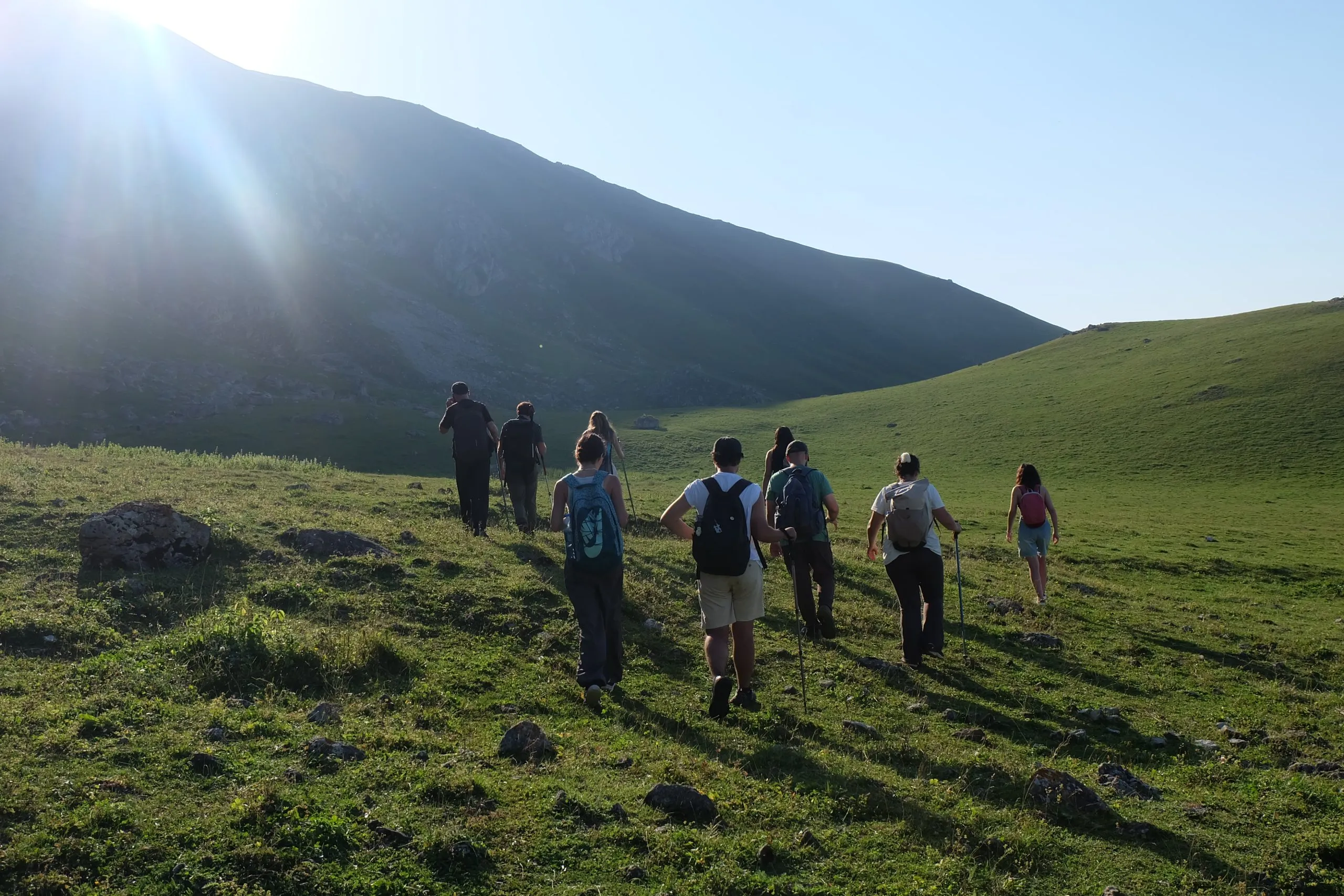
- The pace of the group is the pace of its slowest member. This is not politeness, it is a safety rule.
- Nobody is left alone. There is always an experienced person at the back.
- The split point is agreed in advance. In a place with no coverage, "see you later" is not a plan.
- A decision to turn back is not up for debate. If the guide or the group decides to turn back, that is followed. The summit will still be there.
Attitude to nature
The international "leave no trace" principles are simple:
- Whatever you brought in, carry out — including peel, tissues and cigarette butts. The "it will rot in nature" argument means years even for an orange peel.
- Light fires only in designated and previously used spots; use a stove if you can. Do not open a new fire ring.
- Do not leave the trail. Cutting corners starts erosion and opens a new scar within a few seasons.
- Do not pick plants and do not build cairns — artificial cairns can send others the wrong way.
- Do not feed animals. An animal that returns to a place where it was once fed becomes labelled a problem, and the outcome is bad for the animal.
- Toilet: at least 50 metres from the trail and from water, in a small hole; paper is neither burned nor buried — it goes into a bag and comes back with you.
In villages
Most routes in Azerbaijan pass through living villages. That carries a cultural responsibility:
- Ask before photographing — especially people and homes.
- Crossing pasture and farmland, leave fences and gates as you found them (open if open, closed if closed).
- Buy from the local shop and stay in family guesthouses. The benefit of tourism should stay in the village.
- Behaviour with livestock guardian dogs is a separate topic: shepherd dogs in the mountains.
- Mind the dress code at shrines and temples.
The matter of help
In the mountains nobody who asks for help is turned away. This is the one absolute rule shared by every mountain tradition. Even if it wrecks your own programme, stopping to help a group in difficulty or passing on word is expected.
By the same logic: if someone tells you "that route is closed today" or "the weather is bad up there", treat it as information, not as a personal opinion.
In one sentence
A good hiker leaves two things behind: a footprint, and a place undamaged for whoever comes next. Everything else comes back in the pack.
An operator's attitude to these rules also tells you something when choosing a tour: how to choose a tour operator.
Ready to experience it yourself? See the upcoming departures.
Browse tours